

Halal Mandatory on 17 October 2026: What to Prepare Now
The deadline is weeks away. Here is the most efficient order of work if you are starting today.
Indonesia's platform for halal education, guidance, and consultation. Backed by certified halal auditors, from registration to the certificate in your hand.
The first consultation costs nothing. Median reply under 15 minutes during business hours.

SJPH digitizes every SJPH criterion — following BPJPH Decree 57/2021 as amended by 20/2023 — so your business stays documented, monitored, and audit-ready at all times.
Set the halal policy, appoint the halal management team, and record management commitment as documented evidence.
Ingredient lists with halal status, supporting documents, and critical point (PPH) analysis for every product.
The SJPH manual, written critical-point procedures, and non-conforming product handling are generated from your data.
Schedule internal audits, log findings, manage corrective actions, and prepare management reviews on time.
SIHALAL registration completeness at a glance: material certificates, product data, and production process evidence.
Internal training materials, halal supervisor assignments, and competency records kept tidy in one place.
The first version is under construction — sign up now for priority access and early-bird pricing.
From certification support to halal supervisor training, delivered by a certified team.
Run every SJPH criterion of your business in one app: halal policy, material registry, critical points, internal audits, and BPJPH certification readiness.
From gap assessment to certificate, steered by certified auditors.
The halal self-declaration route for low-risk micro and small enterprises.
The mandatory competency for whoever runs SJPH inside a company.
Ask certified halal consultants and auditors directly.
Our team holds halal auditor competency certificates — not just filing clerks.
Grounded in PP 42/2024, Kepka BPJPH 78/2025 and the latest SJPH criteria, not stale copies.
Official BPJPH and LPH fees are always shown separately from our service fee.
Progress, documents, and visit schedules are visible from your phone at any time.
We map your products, ingredients, and readiness against the five SJPH criteria.
SJPH manual, ingredient register, and registration pack prepared with your team.
We steer the SIHALAL submission and stand beside you through the LPH inspection.
Once issued, we help keep compliance alive so an ingredient change never voids it.
Ask certified halal consultants and auditors directly.
Not sure where to begin.
The status of a specific ingredient and its paperwork.
Manual, procedures, and paperwork completeness.
Whether my business qualifies.
What gets inspected and how to prepare.
Destination-country rules and overseas certificate registration.
Halal supervisors, PPH facilitators, and competency certification.
A question outside the categories above.
Certified halal consultants and auditors ready to help with your certification.
Defines 27 BPJPH services with their requirements, timelines, and fees — including LPH accreditation, LP3H and PPH facilitator registration, certificate issuance, and facilitation codes. Revokes Decree 120/2022.
The complete accreditation guide for LPH: requirements, the Pratama and Utama qualifications, competency scope, fees, application flow, surveillance, and witness assessment. Anchored on SNI ISO/IEC 17065:2012.
Replaces GR 39/2021. It governs the establishment, accreditation, activity scope, and revocation of Halal Inspection Bodies, and the appointment and dismissal of Halal Auditors.
The most recent amendment to Law 33/2014. It streamlines certification, introduces the self-declaration scheme for small businesses, and opens the way for the Halal Product Fatwa Committee.
The deadline is weeks away. Here is the most efficient order of work if you are starting today.
Law 6/2023 changes how halal certification is carried out: a simpler process, a self-declare pathway for UMK (micro and small enterprises), and a Halal Product Fatwa Committee. These are the practical consequences.
Halal certification is a gradual process. Understand the sequence of steps, the documents to prepare, and the role of each party in the certification flow.
The halal critical point of an ingredient is not always the ingredient itself, but its origin and process. Get to know four examples of ingredients and how to trace them.
The halal certification requirement is already regulated. For UMK, the obstacle that most often arises is actually simple: ingredient documents from suppliers that are hard to trace.
Halal certification is not merely a domestic obligation. For export-oriented industries, SJPH (Halal Product Assurance System) becomes part of document readiness and ingredient traceability.
"We were turned down twice because our ingredient register was incomplete. With guidance the process moved and the certificate came through in seven weeks. What helped most was being told why each document mattered."
"Cosmetics involve far more complicated ingredients than food. The IndoHalal team mapped every critical point and drafted the questions we needed to put to our suppliers. That saved us months."
"We registered 42 cooperative members through the self-declare route. The facilitator came to our centre, so members did not have to travel back and forth. Everything closed within a month."
For food, drink, slaughter products, and slaughter services from micro and small enterprises, the deadline is 17 October 2026. Medium and large businesses in the same group have been obliged since 17 October 2024. Traditional medicine, supplements, cosmetics, chemical products, biological products, genetically engineered products, and consumer goods also fall due on 17 October 2026.
The regular route involves inspection by a Halal Inspection Body (LPH) and a halal determination by the MUI Fatwa Commission. The self-declare route is only for micro and small enterprises with low-risk products and unambiguously halal ingredients; it is verified by a PPH facilitator and determined by the Halal Product Fatwa Committee.
On the regular route the service application fee is Rp300,000 (Rp200,000 for registration, document check and certificate issuance; Rp100,000 for the halal determination), plus the LPH inspection fee, which depends on the number of production facilities, mandays, and travel. For small businesses on the regular route the common total is about Rp650,000. These go to BPJPH and are separate from our service fee.
No. Halal certificates are issued solely by BPJPH. Halal status is determined by the MUI Fatwa Commission (regular route) or the Halal Product Fatwa Committee (self-declare). Our role is to prepare the system, the documents, and the guidance that gets you through.
It depends on how ready your paperwork is. The self-declare route for small businesses can finish in two to four weeks when the file is complete. The regular route usually runs one and a half to three months, with most of that time spent assembling the ingredient register and chasing supplier documents.
A halal certificate stays valid as long as the product and its ingredients do not change. You are, however, obliged to report every ingredient, supplier, or process change to BPJPH and to keep the SJPH alive. An unreported change can void the certificate.
Bukan ilustrasi — geser untuk melihat cuplikan tiap aplikasi dalam ekosistem, dari situs web sampai aplikasi di ponsel Anda.
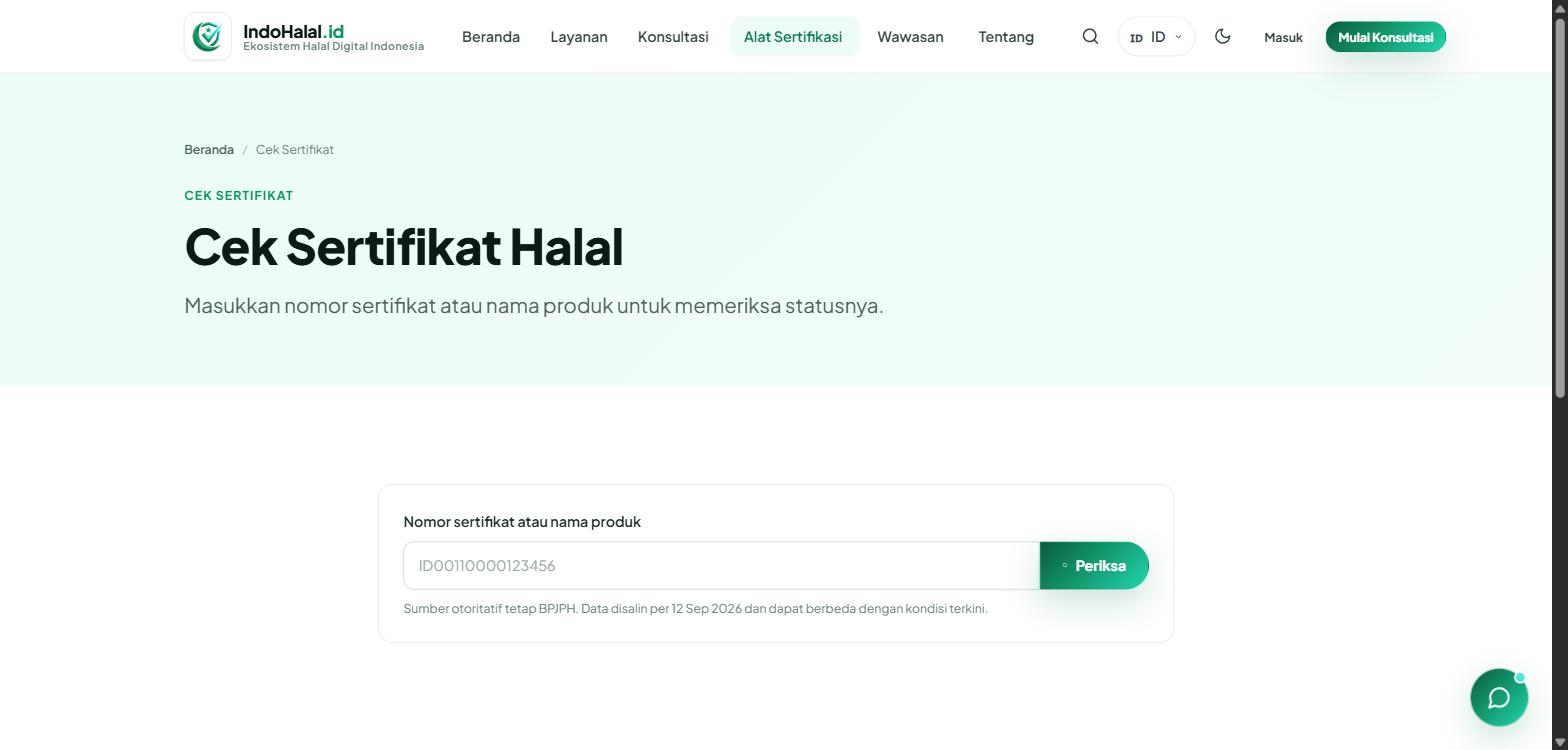
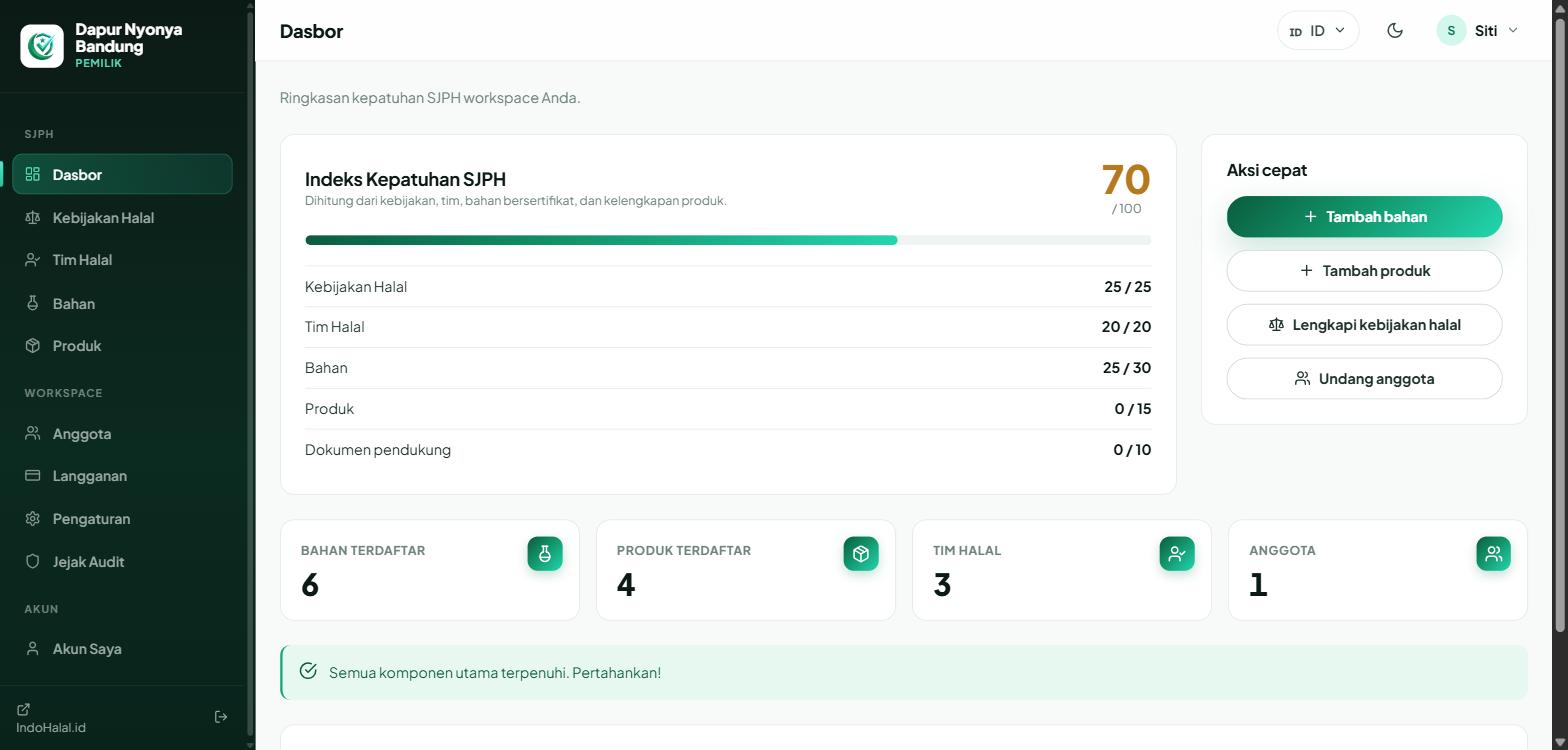
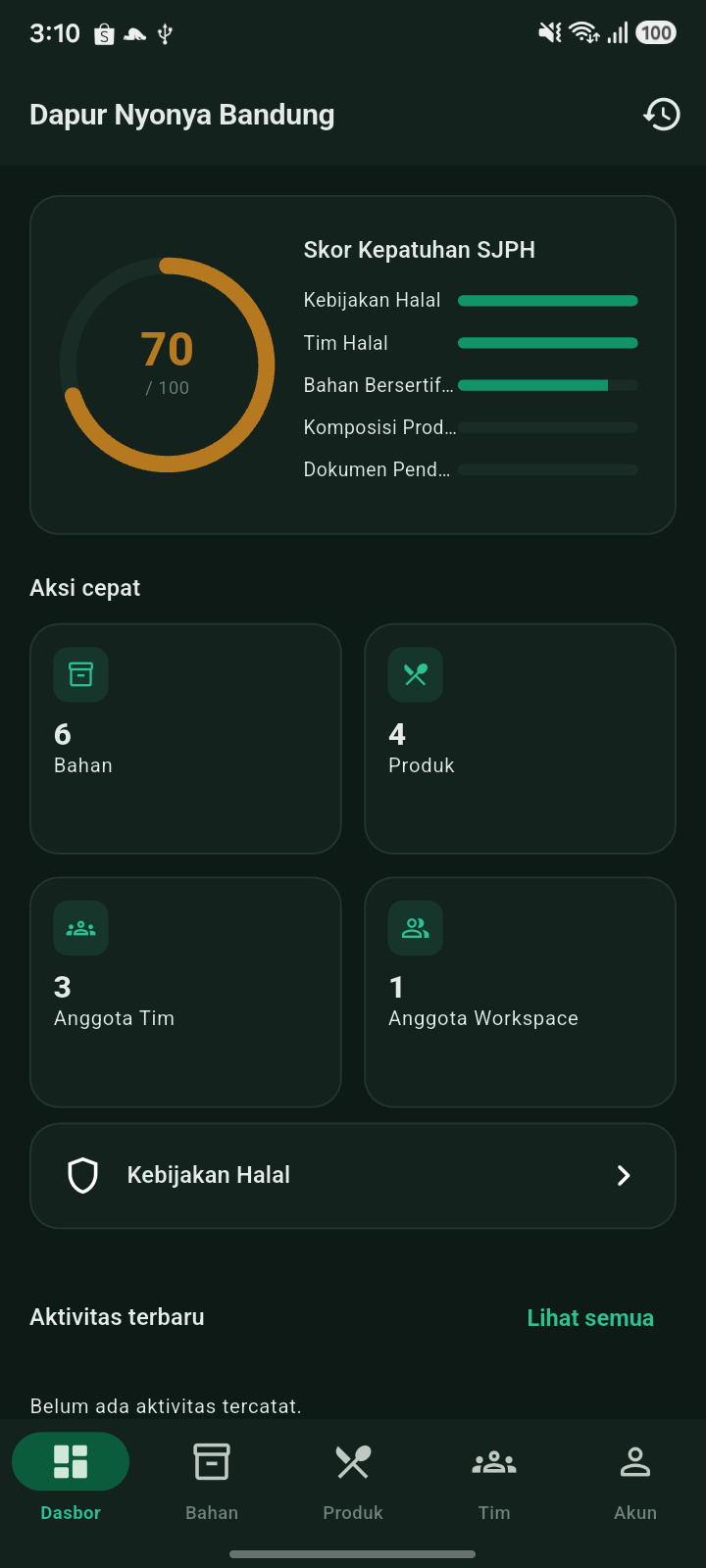
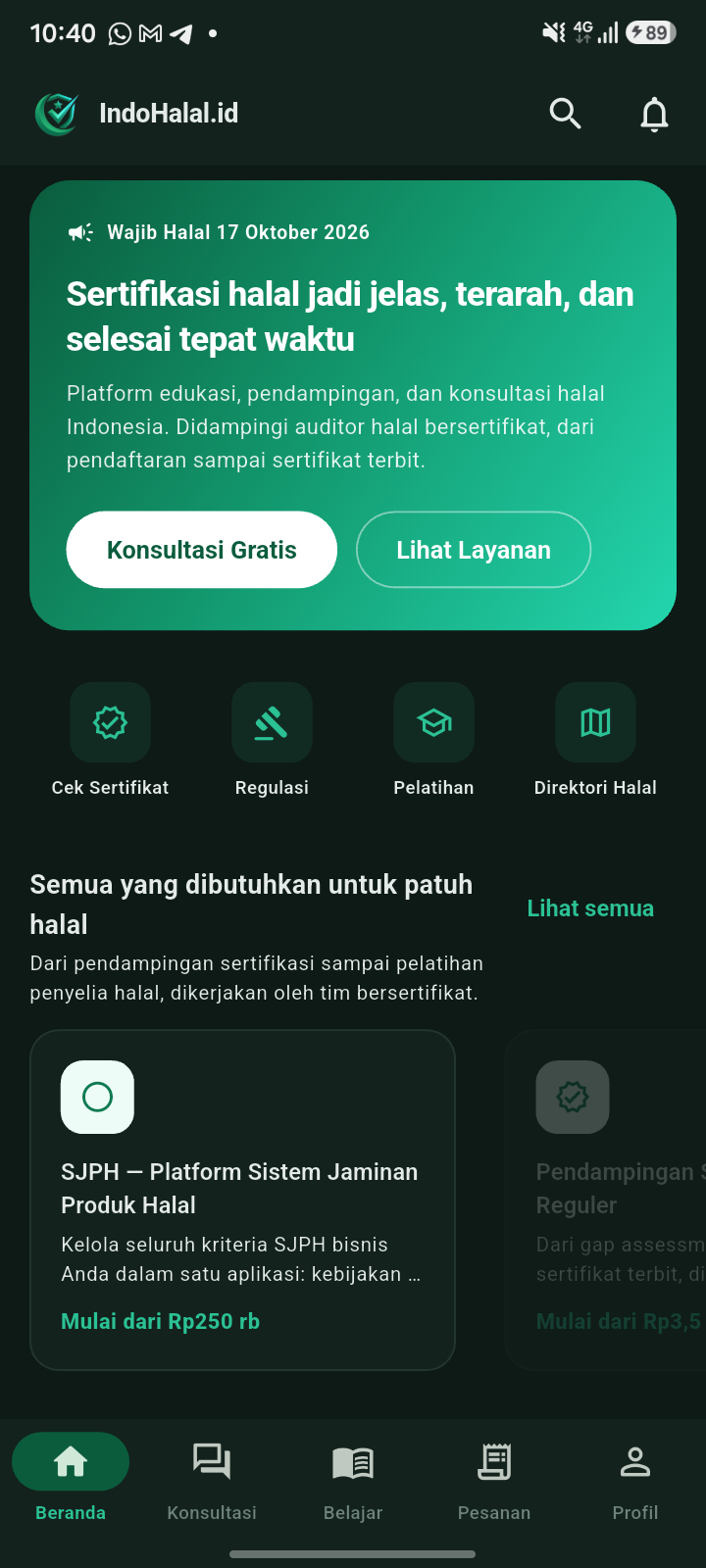
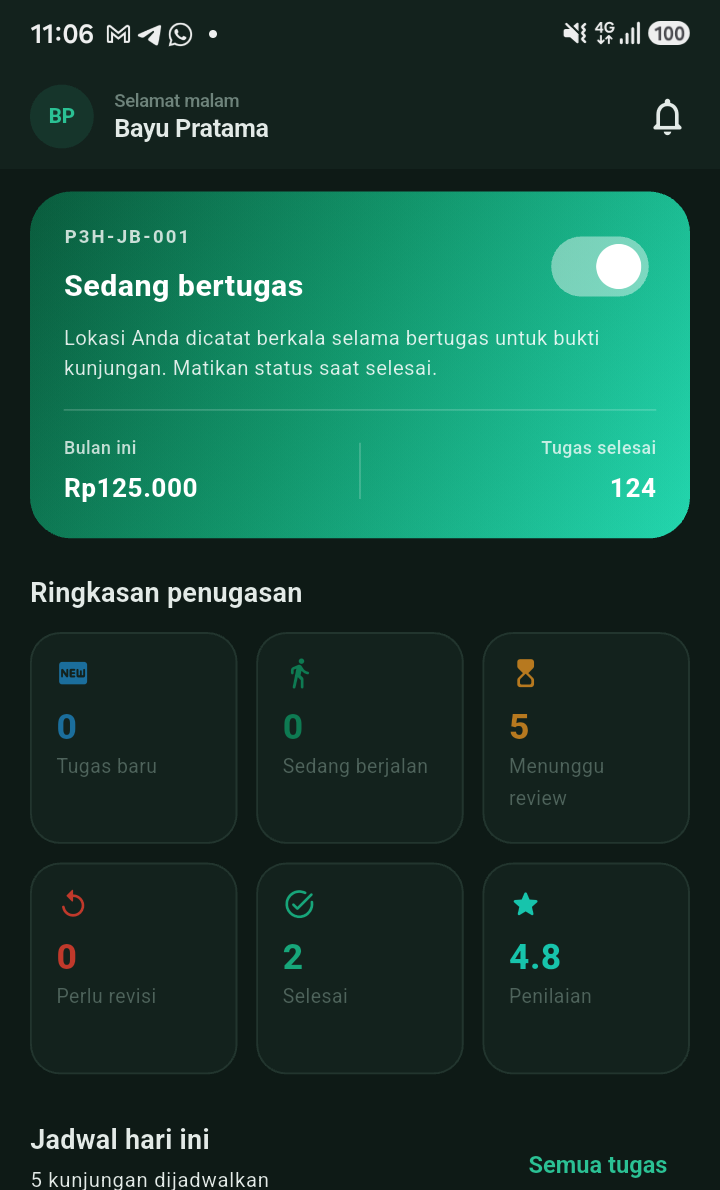
Verify certificates, browse the halal product directory, and pick up your consultation anywhere.


The first consultation costs nothing. Median reply under 15 minutes during business hours.
Ask certified halal consultants and auditors directly.
Jawaban konsultan bersifat panduan teknis. Penetapan kehalalan produk adalah kewenangan Komisi Fatwa MUI atau Komite Fatwa Produk Halal, dan sertifikat halal hanya diterbitkan oleh BPJPH.